The Factory Is the Technology
Manufacturing · June 5, 2026 · 9 min read
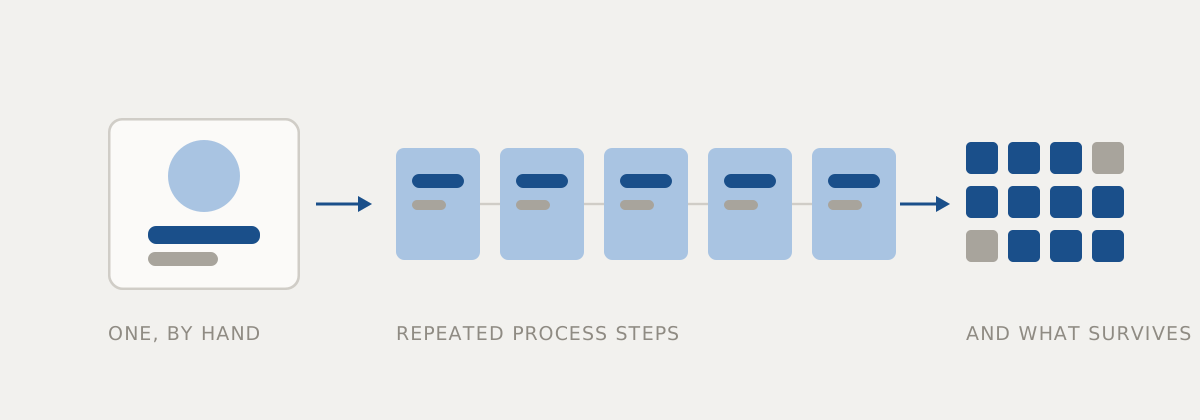
There is a moment in every clean energy hardware story that gets photographed: the first unit runs. It converts, stores, moves or cleans something, the instruments agree, and everyone in the room is entitled to be pleased. What almost nobody outside the industry understands is that this moment tells you very little about whether the thing will ever be built at volume, and nothing at all about when.
The device is one invention. The process that produces the device ten thousand times a week, to the same specification, from materials bought on commodity terms, with a scrap rate low enough to survive a competitive market, is a second invention. It is generally harder, it is certainly slower, and it is the one that decides the outcome.
What a laboratory optimises for is the wrong thing
A demonstration unit is built to prove a mechanism. Everything else is negotiable: the technician can hand-align a component, the deposition can run at a leisurely rate, a marginal part can be discarded and replaced without anyone recording it. The unit that emerges is a proof that the physics works when the process is unconstrained.
A production unit is built to a completely different brief. Every step must complete within the same cycle time as every other step, or the line paces to the slowest one and the capital sits idle. Every step must tolerate the variation in the incoming material, because the supplier who is cheap is cheap partly because their tolerances are wide. Every step must be performed by equipment that can be bought, maintained and staffed, not by the one person who has the knack.
Design for manufacture is therefore not a polish applied to a finished design. It usually reverses the design’s original priorities. The laboratory version chose a material because it performed best; the production version chooses one that performs adequately and can be sourced from more than one continent. The laboratory version used a step because it was clean and controllable; the production version removes that step entirely, because a step is a machine, a footprint, an operator, a maintenance schedule and a yield loss, repeated for every unit forever.
Yield is multiplicative, which changes everything
The single most under-appreciated fact about a production line is that yields multiply. If a process has many stages and each stage occasionally produces something out of specification, the fraction of material that survives the entire sequence is the product of all those individual survival rates, not the average of them.
Two consequences follow, and they shape how these factories are designed.
The first is that adding a process step is expensive even when the step itself is nearly perfect. A stage that almost never fails still drags the whole line down a little, permanently. This is why mature manufacturing organisations are obsessed with step count in a way that looks almost superstitious from outside — removing a step improves cost, throughput and yield simultaneously, which nothing else does.
The second is that early-life yields are brutal. A line that has just been commissioned is running every stage at its worst, and those worst cases compound. The output in the first months of a new plant is not a slightly reduced version of the design output; it can be a small fraction of it. That gap has to be financed, and financing it is the point at which a lot of otherwise sound hardware businesses fail. They did not run out of technology. They ran out of runway during the ramp.
The learning happens on the line and cannot be bought
Process knowledge is largely tacit and largely local. It lives in the settings that were changed after a bad week, in the inspection someone added because a defect kept recurring, in the knowledge that a particular tool drifts after a certain number of hours. None of that transfers cleanly by hiring a consultant or buying the same equipment, which is why two plants running nominally identical lines can have persistently different costs for years.
This is also why the timeline resists compression. Tools have lead times measured in quarters. Commissioning is sequential — you cannot debug a stage properly until the stage before it produces representative material. Each qualification cycle requires building parts, testing them, changing something and building more. You can spend more money to run experiments in parallel, but the physical clock of build-test-learn does not respond to capital the way software timelines do.
Then, on top of the process clock, there is the acceptance clock. Hardware that goes into an energy asset has to be insurable and financeable, which means it has to be certified to the relevant standards, warranted by an entity plausibly able to honour the warranty, and ideally already operating somewhere without incident. A genuinely better product with no operating history is, from a lender’s point of view, an unpriced risk. The manufacturer’s problem is that the operating history can only be accumulated in real time.
A note on the word
“Cleantech” is, honestly, a slightly dated term. It belongs to a particular period of enthusiasm, and it carries some of that period’s residue: a wave of investment that treated energy hardware like software, funded a great many demonstrations, and discovered the scale-up problem described above the expensive way. Much of the field now says “climate tech” instead.
The change is not only cosmetic. “Cleantech” describes a class of technology — things that are clean rather than dirty, mostly generation equipment. “Climate tech” describes a problem and admits that the answer includes things nobody would call clean technology: industrial process changes, measurement and accounting software, financial instruments, grid operations, adaptation. The vocabulary widened because the scope of what visibly matters widened, and because the older word had acquired a faint smell of a cycle that ended badly.
It is worth knowing both terms and what they signal. It is not worth arguing about, and the machinery does not care what it is called.
The useful question
When someone tells you a clean energy technology is ready, there is a question that separates the claim from the reality: what is currently the binding constraint on deploying more of it?
If the answer concerns physics or chemistry, the technology is genuinely early and the timeline is long and uncertain. If the answer is that the plant that makes it is running at capacity and the next one takes two years to build, the technology is done and the problem is capital, sites, equipment and skilled process staff. And if the answer is that the product exists in a warehouse but cannot connect to anything, the problem is not manufacturing at all.
Those three situations look identical in a press release and require entirely different responses. Most of what gets discussed as innovation in this sector is in the second category, which is not a failure of imagination. It is what it looks like when a technology has started working and the world has to be re-tooled to accept it.