Duration Is Not Power
Storage · July 9, 2026 · 10 min read
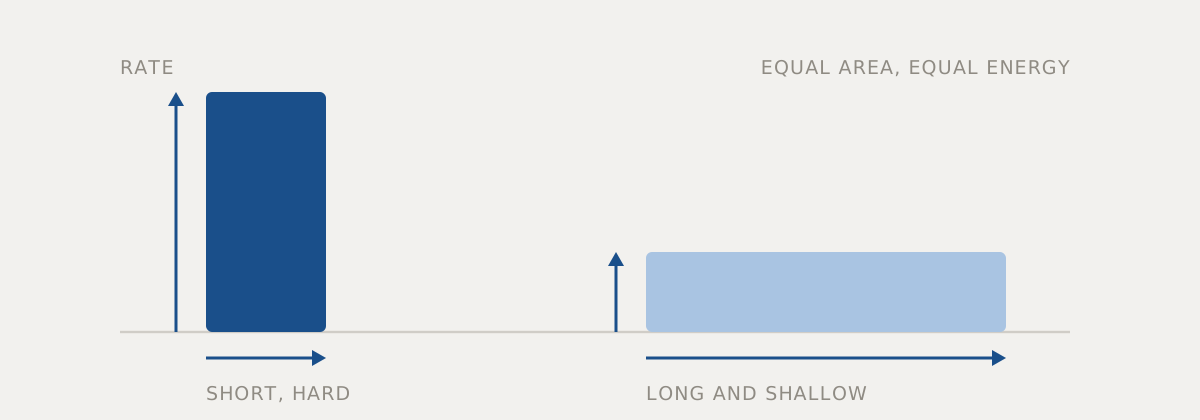
Storage is routinely described with one number, and one number is never enough. A figure in megawatts gives the rate at which the installation can move power; a figure in megawatt-hours gives how much it can move before it is empty. Neither implies the other, they are supplied by different parts of the system, and almost every misunderstanding about storage comes from collapsing them into one idea called “capacity”.
The ratio between them is duration: energy divided by power, in hours. It is the most informative single thing you can know about an installation, and — unlike most engineering parameters — close to a free choice at the design stage.
The two ratings are bought separately
Power capability lives in the conversion and connection equipment: inverters, transformer, switchgear, cabling, protection, the grid connection itself. These set the maximum rate, and their cost scales with that rate rather than with the stored quantity.
Energy capability lives in the storage medium. For an electrochemical system that is cells, so the cost of adding hours is close to the cost of adding cells, plus the enclosure, thermal management and fire engineering that come with them.
Because the two costs sit in different places, they trade almost independently. Doubling the hours on a fixed power rating does not require larger inverters; doubling the power on a fixed energy content does not require more cells, though it does work the cells harder. That constraint is expressed as the C-rate — the rate of charge or discharge relative to the stored energy — and the limits on it are thermal and chemical rather than commercial.
The sensible way to specify storage is therefore as a pair, and the sensible way to compare two installations is to compare their durations first.
Services want different shapes
Duration is a design choice rather than a preference because different grid services have completely different energy requirements behind the same power requirement.
Fast frequency services want a rapid change in output held for a short period. The megawatts do the work; the megawatt-hours consumed are small, and the response is often symmetric enough that the state of charge barely moves. A very short-duration asset can sell this.
Energy shifting is the opposite: the value comes from absorbing when energy is abundant and releasing when it is scarce, and both halves occupy hours. Power limits how much can move per hour; duration limits how much can move at all.
Capacity adequacy — being counted on when the system is tight — is the subtle one. What matters is sustaining output for the length of the actual stress event, and stress events do not have a single length. They have a distribution, and that distribution is local: it depends on the demand shape, the generation mix and the weather of the specific system. An asset’s contribution to adequacy falls away as its duration falls short of the events that matter, and where it falls away cannot be read from a datasheet. It comes from the system’s own history.
Stacking is constrained by one shared resource
The commercial case for storage usually involves selling several of these services from the same asset. This is legitimate and it is also where the arithmetic quietly breaks.
State of charge is a single shared resource. A commitment to provide upward response requires headroom to discharge; a commitment to provide downward response requires room to charge; an arbitrage strategy wants to be full before the expensive hours and empty after them. These are competing claims on one variable, not independent claims on the asset, and they are not satisfied by adding up the revenue from each as though it could be in several states at once.
A real dispatch strategy solves a constrained optimisation in which reserving capability for one service reduces what is available for another. An honest revenue stack shows that interaction — what shifting gives up to stay compliant with a response obligation, and how often the two conflict. Stacks presented as simple sums describe an asset that does not exist.
The marginal hour is worth less than the one before it
There is a general shape to the answer when choosing how many hours to build, and it is not “as many as affordable”.
The first hour of duration is used almost every day, because narrow price separations occur constantly. Each additional hour is used less often, since only the wider separations call on it, and it captures a smaller spread when they do. Each additional hour costs roughly the same as the last, because it is the same cells.
Declining marginal value against constant marginal cost produces an optimum, and where it sits depends on the shape of local prices, the rules of any capacity mechanism, and how much of the day the system is actually short. It moves as the system changes: adding a generation source with a strongly diurnal profile deepens and lengthens the periods that need covering, which pushes the optimum out. That is a statement about mechanism, not a forecast.
Degradation is a throughput budget
Cells age two ways. They age on the calendar, whether or not anything is asked of them, and they age with use, roughly as a function of how much energy has passed through them and how deeply and how fast it was cycled.
Warranties are typically written against both — a period, plus an energy throughput or cycle count, with retained-capacity guarantees conditioned on staying inside defined operating limits. That turns cycling into a budget. A strategy that captures every small spread spends warranty on transactions that may be worth less than the warranty they consume, and a dispatch optimiser that ignores this is optimising the wrong objective.
Duration interacts with this directly. Delivering a given quantity of energy from a longer-duration asset means shallower cycling, and shallower cycles are gentler per unit of energy delivered. Some of the value of extra hours is therefore not extra energy at all; it is a slower rate of consuming the asset.
Where the efficiency is measured changes the number
Round-trip efficiency is quoted constantly and defined inconsistently. What matters is where the measurement boundary sits. A figure taken at the cell terminals excludes the conversion stages, the transformer and the auxiliary loads — thermal management, controls, fire and safety systems. A figure taken at the grid connection includes all of them, and it is the only one relevant to revenue, because that is where the energy is bought and sold.
Auxiliary consumption also behaves differently from the rest: much of it runs whenever the installation is energised, not only when it is cycling. For an asset that sits idle most of the time — which describes anything built for infrequent long events — standing losses can be a meaningful share of throughput, while for a heavily cycled short-duration asset they are a rounding error. The same equipment has a different effective efficiency depending on how it is used.
Long duration is a different question
Extending this reasoning far enough changes the technology. As the required hours grow, the cost of the energy container dominates, and the properties that make a good short-duration system — power density, high efficiency, fast response — matter progressively less than cost per unit of stored energy.
Long-duration storage is therefore not more of the same equipment but a different design problem, one in which poor response characteristics and unremarkable efficiency can be entirely appropriate provided the container is cheap enough. Judging such a system by short-duration metrics gets the answer wrong in a completely predictable direction.
Two numbers, then, not one — and a clear statement of the shape of the demand the asset is supposed to cover. Everything else in a storage business case is downstream of those.