Cost Curves Are Built, Not Discovered
Economics · July 28, 2026 · 10 min read
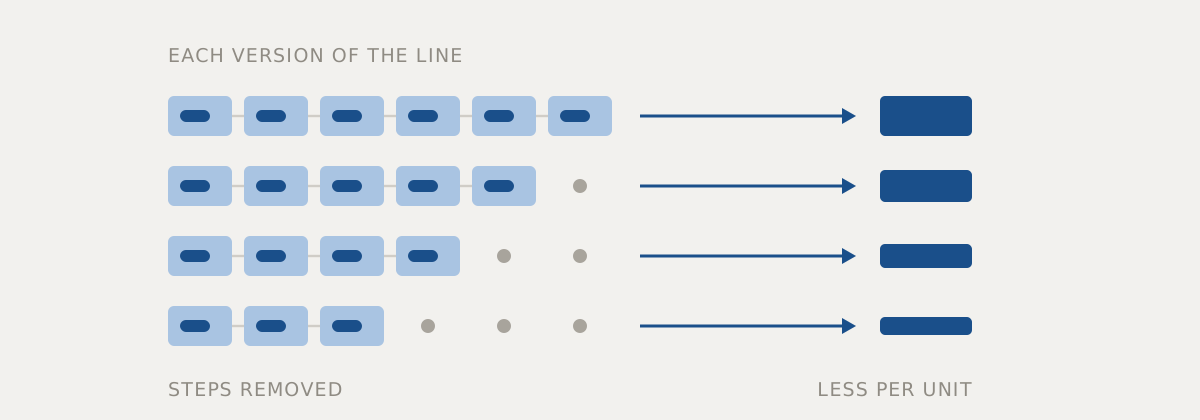
The popular account of falling clean energy costs is a story about discovery: a laboratory finds something, the finding is commercialised, prices fall. It is a satisfying shape and it is mostly wrong. The dominant mechanism is duller and more interesting — an enormous number of small process improvements, each individually unremarkable, accumulating in proportion to how much has been built.
This distinction is not academic. It determines what you should expect from a given technology, what you should do to make its costs fall, and whether waiting for something better is a strategy or an excuse.
Cost falls with cumulative production, not with time
The empirical regularity that describes manufactured goods is a relationship between unit cost and cumulative output: each doubling of everything ever produced is associated with a roughly constant proportional reduction in cost. The important word is cumulative. The independent variable is not the calendar and it is not research spending. It is how many units have been made.
That makes the relationship reflexive in a way ordinary technological progress is not. Building things is not merely the consequence of cheaper things; it is the cause. A policy that increases deployment is not buying expensive units — it is buying the experience that makes later units cheap, and that learning sits in firms, workforces and supplier relationships which only exist if there is production for them to exist around.
The corollary is uncomfortable for anyone hoping to wait. A technology that is not being built is not getting cheaper. It may be getting more sophisticated in a laboratory, which is a different thing, and the gap between the two is exactly the scale-up problem.
What actually gets improved
If you take apart a cost reduction that occurred over some period in any mature hardware line, you find a long list of specific changes. They fall into a small number of recognisable categories.
Less material per unit of function. Making the load-bearing or active part thinner, using less of the expensive constituent, replacing a scarce input with a common one. This category also includes efficiency improvements, because a device that converts more of its input into useful output delivers more function from the same quantity of material, mounting, wiring and land.
Fewer steps. Every process stage is capital, floor space, labour, maintenance and a yield loss repeated forever. Combining two steps into one, or discovering that a step was compensating for a defect that has since been designed out, removes all of those at once. This is the highest-leverage change available and it is almost always invisible from outside.
More throughput per tool. Faster line speed, wider processing, larger unit size, longer uninterrupted runs. Fixed costs — building, utilities, supervision, amortisation — spread over more output. Much of what looks like a dramatic improvement in a mature industry is simply that the same factory now produces considerably more.
Higher yield. Discussed elsewhere on this site, and worth repeating here because it acts on cost twice: scrapped material is paid for and thrown away, and the capacity consumed producing it was capacity that could have produced sellable output.
Standardisation. Fewer variants mean longer runs, fewer changeovers, cheaper tooling per unit, and — critically — a supply chain able to specialise. Once a component is standard, someone can build a business doing nothing but that component, at a scale no integrated manufacturer would reach, and compete on it. Vertical disintegration is one of the most reliable signals that an industry has entered its cost-reduction phase.
Installation and balance of system. For anything deployed in the field, a large share of delivered cost is not the device. It is mounting, wiring, foundations, civil works, inspection and labour hours on site. These improve through modularity and pre-assembly — moving work from the site, where it is slow and weather-dependent, into a factory, where it is repeatable.
The cost of money. As a product accumulates operating history and its failure modes become known, lenders and insurers price it lower. That is a genuine reduction in the cost of delivered energy which never appears in an equipment price, and it is one of the largest single components of the improvement for capital-intensive assets.
None of these is a breakthrough. All of them are engineering, procurement and industrial organisation, performed continuously by people whose names do not appear in the coverage.
Why some technologies learn and others do not
The learning rate is not a universal constant. It varies enormously between technologies, and the variation is largely explained by two structural properties.
The first is unit repetition: how many times the identical article gets built. A device made thousands of times a day accumulates cumulative production quickly, and every improvement is tested against a large sample almost immediately. Something assembled a handful of times, each to a slightly different specification, accumulates almost nothing. The feedback loop that drives learning needs repetition, and repetition needs the article to be the same each time.
The second is where the work happens. Factory work is controlled: conditions are constant, tools are fixed, measurement is continuous, and a change can be evaluated properly. Site work is the opposite — every location differs, the workforce turns over, and the same nominal task takes a different number of hours each time. Cost reductions in field work are real but slower, and mostly come from moving work off the site rather than doing site work better.
This is why the technologies with the steepest cost declines have all been modular, factory-produced and deployed in large numbers, while things built as large bespoke projects on individual sites have improved slowly or not at all. Some have become more expensive over time, which the learning framework does not forbid: a first-of-a-kind is followed by an nth-of-a-kind only if there is an nth, and a stop-start pipeline disperses the workforce and supplier base that held the learning. When the next project starts, the organisation rebuilding it is not the one that finished the last one, and the curve restarts from a worse position.
What the breakthrough framing costs
Believing that costs fall through discovery has three practical consequences, all bad.
It misallocates attention. The activities that produce most of the improvement — process engineering, tooling, quality systems, supplier development — are treated as execution rather than as the innovation they are, and staffed accordingly.
It makes waiting look rational. If improvement arrives from outside as a breakthrough, deferring deployment until it arrives is prudent. If improvement is produced by deployment, deferral is what prevents it.
And it distorts what gets funded. A story about a novel mechanism is easier to tell than a story about removing a step from a line, so capital flows toward the former even though the latter is where the returns and the risk reduction actually are.
What to look for instead
A reasonable set of questions about whether a technology’s costs will fall, none of which require a forecast:
Is the article converging on a standard form, or is every one different? Is production volume growing steadily, or does it move in a policy-driven sawtooth? Are steps being removed from the process, or added to compensate for problems? Is the supply chain specialising, or does each manufacturer still make everything? Is field labour being moved into factories? And is anything being built at all, continuously, by an organisation that will still exist to build the next one?
Those are the conditions under which a cost curve exists. They are unglamorous, they are largely industrial rather than scientific, and they are the whole game.