Everything Waits for the Interconnection
Grid · June 22, 2026 · 10 min read
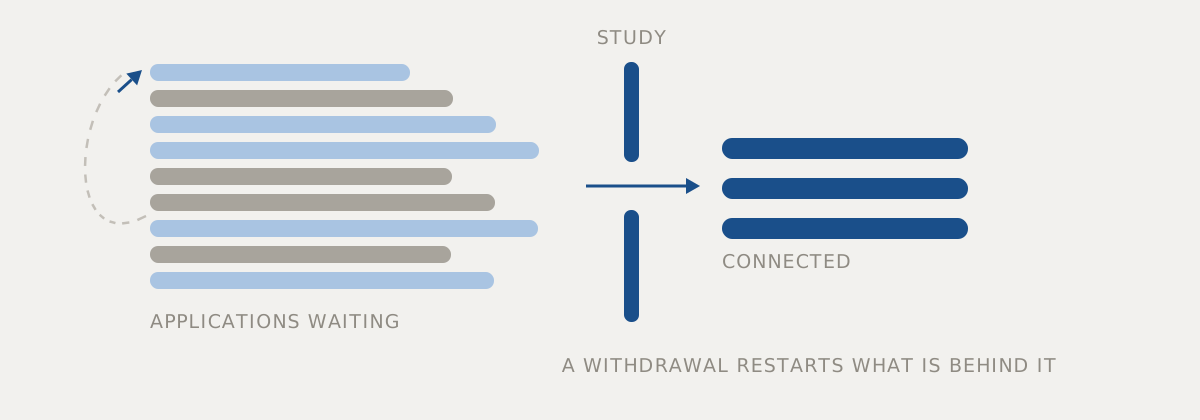
A developer can own the land, hold the permits, sign the offtake, and have the equipment on a ship, and still not know within a couple of years when the project will produce a unit of electricity. The uncertainty is almost never in the hardware. It is in a queue.
Interconnection is where a great deal of otherwise finished clean energy sits and waits, and the reasons are structural rather than bureaucratic. Understanding them is the difference between treating the delay as an outrage and treating it as a design problem with known failure modes.
Why there has to be a study at all
Adding a generator to a network is not like plugging in an appliance. Power flows along every available path according to the impedances of the network, so an injection at one point changes loading, voltages and fault currents at points far away from it. The relevant questions — will any line exceed its thermal rating under credible outage conditions, will voltage stay inside limits, will protection still discriminate correctly, will the system remain stable after a fault — cannot be answered by inspection. They require simulation against a model of the network.
That is the first structural fact: a connection request generates work proportional to the complexity of the network, not to the size of the project.
The second is worse. The answer for any one project depends on what else is assumed to be connected. A line that has spare capacity when your project is studied alone may be fully loaded once the four projects ahead of you are built. So the studies are done against a baseline that includes everything earlier in the queue — which makes the results of every study contingent on the survival of every project ahead of it.
Contingency produces cascades
Follow that contingency through and the pathology appears on its own.
Suppose a project some distance up the queue withdraws. Everything behind it was studied against a baseline that assumed it existed. That baseline is now wrong, generally in a favourable direction, but wrong. Strictly, the studies must be redone. Redoing them changes the required network upgrades, which changes the costs allocated to the remaining projects, which changes whether some of them are still viable — and each of those that now withdraws invalidates the baseline again.
A queue with sequential dependency and voluntary exit will oscillate. Each round of restudy takes months, and the outputs of one round are inputs to decisions that generate the next round. This is the mechanism behind the phenomenon everyone observes: queues that grow faster than they are processed, in which a majority of entries eventually withdraw, while the entries that intend to build wait behind entries that do not.
The standard response is to study projects in batches rather than one at a time — a cluster with a defined entry window, evaluated as a group and assigned costs collectively. Clustering genuinely reduces the cascade, because withdrawals inside a cluster are absorbed by it rather than propagating down an endless tail. It also has costs: everyone waits for the window to close, a project that is ready early is paced by the least ready member of its cohort, and allocating shared upgrade costs among members is a negotiation with no obviously correct answer.
The queue is full of options, not projects
The second pathology is that queue entry is usually much cheaper than the thing it reserves. A position in the queue is an option on future revenue: if power prices, policy or land values move favourably, exercise it; if not, walk away. Rational developers therefore submit more applications than they intend to build, at more sites than they control, at larger capacities than they expect to install.
The result is a queue whose length says almost nothing about how much generation is actually coming. Worse, the speculative entries consume the scarce resource — engineering study capacity — and impose their assumed injections on everyone behind them.
Every remedy is a variation on making the option cost something: meaningful deposits, evidence of site control, demonstrated financing, milestone-based withdrawal penalties, readiness criteria that must be met before a study slot is allocated. They work, in that they shorten queues. They also, unavoidably, favour well-capitalised developers and convert a first-come-first-served system into one that rewards balance sheets. That trade is not resolvable by a cleverer rule; it is a choice about who gets to develop.
Who pays for the reinforcement
Underneath the scheduling problem is a cost allocation problem that is genuinely hard.
Some connections require nothing more than the physical connection assets — a bay, a transformer, a short spur. Others trigger reinforcement deep in the network: a line rebuild, a new substation, an upgrade tens of kilometres away that is necessary only because of the aggregate of several projects, and which will benefit projects that connect afterwards for free.
If the triggering project pays the whole cost, then the marginal project bears an expense caused collectively and enjoyed by later entrants. Since queue position determines who is marginal, the allocation is close to a lottery, and the rational response is to withdraw and re-enter later — which is exactly what happens, and which lengthens the queue further. If instead the cost is socialised across all users, then nothing in the siting decision reflects where the network has spare capacity, and developers site projects where land is cheap rather than where the grid can accept them.
Real regimes sit somewhere between the two and are re-argued regularly, because neither pole is defensible on its own. The point for anyone assessing a project is that “shallow” and “deep” connection charging are not accounting details. They change which sites are viable and by how much, and the same project can be excellent under one regime and unbuildable under the other.
Steel and crews have their own queue
It is tempting to conclude that this is all a paperwork problem. Some of it is.
Transmission-class transformers, switchgear, high-voltage cable and the crews qualified to install them are constrained in their own right, on lead times that respond to capital slowly and with a lag. Building a new line additionally requires consent over a corridor of land, which is slower and more contested than consenting a generator on a single site, because the benefits are diffuse and the visual and land-use costs are extremely local.
Even a perfectly administered queue would therefore still be rate-limited by physical construction. Process reform moves projects to the front of the line faster. It does not manufacture headroom.
What the constraint does to project design
Once interconnection is understood as the binding constraint, several choices that look like compromises start looking like sound engineering.
Accepting a non-firm or flexible connection — one that can be curtailed under defined conditions in exchange for a much earlier date — trades some annual energy for years of earlier revenue. Whether that is a good trade depends on how much curtailment actually occurs, which is site-specific and which no generic assumption answers.
Co-locating storage or demand behind the same connection point raises the utilisation of a scarce grid asset without requiring a new one. Sizing an installation so that its export never exceeds an existing connection capacity can be worth more than the energy given up. Re-siting to a location with existing headroom, even a worse resource, can beat a better site with a decade of waiting.
None of that is exciting. All of it is what it looks like to optimise against the constraint that is actually binding rather than the one that is easiest to talk about.